Exercise
Overhand Throwing Cues: An Elementary PE Lesson
By Dave Joisil (Mr. J) · Certified Health and Physical Education teacher
Updated
Break an overhand throw into sideways setup, opposite-foot step and follow-through, with an original sequence picture and supervised target-lane record.
An overhand throw uses a sideways preparation, an opposite-foot step, body rotation, and an arm action that sends the object over the shoulder toward a target. Teach the sequence slowly with a soft object before introducing power, distance, or a receiving partner.
Choose a clear area with an approved backstop, broad target, and empty space beyond. Each lane points in the same direction. Check that equipment is soft, intact, hand-sized, and appropriate for the learners. Stop for pain or distress; a throwing lesson should not require forced shoulder positions.
Picture the sequence before the first throw
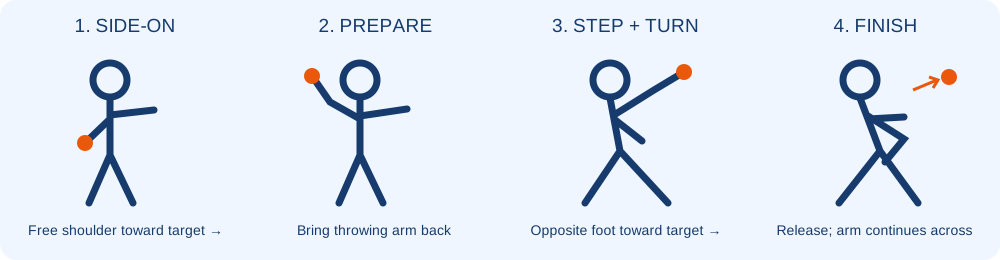
The picture is a simplified reminder, not a precise biomechanical model. Demonstrate from the side and front so children can see the throwing hand and opposite foot. Mirror the foot choices for left-handed throwers; do not require everyone to use the same hand.
1. Sideways setup
Stand with the non-throwing shoulder generally toward the target. For a right-hand throw, that is the left shoulder. Point toward the target with the free arm if helpful, keeping the position comfortable. First practice identifying the front shoulder without holding an object.
2. Prepare, step and turn
Bring the throwing arm back comfortably, then step toward the target with the opposite foot. Let the hips and shoulders turn toward the target as the throwing arm comes forward. Teach this as a connected action rather than holding a strained pose while waiting for a cue.
3. Release and finish
Release over the shoulder toward the target and let the arm follow through naturally across the body. Keep the throw controlled enough to stay within the approved area. Do not tell beginners to throw as hard as possible in a small target lesson.
Game: One feature, broad target
Give each learner a single focus card: side-on, opposite step, or finish. They rehearse without equipment, make one gentle throw when the adult opens the lane, then describe or point to the feature they tried. A target miss does not cancel a successful movement observation.
Everyone places objects down and stops before the adult's retrieval signal. Walk to collect only when all lanes are closed, then return behind the throwing line. No child acts as a target, goalkeeper, or collector during live throws.
Copy-and-print: Overhand sequence check
- Throwing hand: right / left / agreed option ______.
- Picture cue selected: SIDE → PREPARE → STEP AND TURN → FINISH.
- Opposite foot for today's hand: ______. Show it without a ball first.
- Lane line ______; backstop ______; empty target area confirmed ______.
- One observation: started side-on / stepped opposite / turned / followed through / needs another model.
- Next adjustment: softer object / nearer target / slower demonstration / individual support ______.
Adjust the task without mislabeling it
A learner using a supported seated position may practice an individually suitable sending action without the standing step. Explain what is shared, such as directing the object, and what is different. Do not reposition a child or mobility device to force the pictured pattern; follow their plan and consult the appropriate specialist.
For an arm swing below the waist, use the separate underhand throwing lesson. For beginners who need a floor-level sending task, try ball rolling. Neither is a punishment for finding overhand throwing difficult.
The sequence draws on throwing cues in PDST fundamental movement skill cue posters and Scoilnet's throwing guidance, which recommends suitable soft objects and a separate initial throwing focus. The picture, game and check sheet are original, non-diagnostic resources.