Teaching & SEL
No Biting Song for Kids: Teach Safe Choices with I Don’t Bite!
By Dave Joisil (Mr. J) · Certified Health and Physical Education teacher
Updated
Turn I Don’t Bite! into a practical preschool lesson with short scripts, picture cues, puppet practice, and safer ways to ask for help.
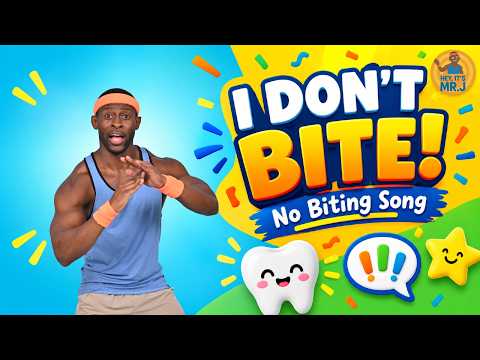
A no biting song is most useful when children practice what to do instead—not just repeat what they should not do. Mr. J’s I Don’t Bite! names several alternatives: ask for help, ask for space, communicate a need, and move to a safer place with adult support. The central message is simple: feelings are okay, and people need to stay safe.
Use the video above for a calm teaching moment before playtime, centers, or a familiar difficult transition. It is a rehearsal tool, not a response to an active injury or a proven treatment for biting. Adults still need to supervise, respond to children’s needs, and help them use the skills.
What the song teaches
The lyric “If I need help, I let you know” gives children a concrete action. Other phrases include “Stop,” “Not yet,” and “I need some space.” Pick one or two that match your classroom rather than asking children to memorize every possible response at once.
For this lesson, “use your words” means communicate in an accessible way. Speech, a familiar sign, pointing to a help picture, and an augmentative and alternative communication device can all count. Children should never have to speak a complete sentence before an adult helps them.
Why teaching an alternative matters
NAEYC’s guidance on children who bite describes several possible reasons, including frustration, teething, oral exploration, and difficulty communicating needs. The song focuses on feelings and communication, but those are not the only reasons a child might bite.
That distinction matters in practice. A child who needs more space may benefit from an adult clearing a crowded area. A child with oral discomfort may need a different kind of support. Repeating a chorus louder will not identify or meet either need.
A short preschool lesson
1. Introduce the boundary
Say, “Teeth do not hurt people. If something is wrong, I will help you.” Keep your tone calm and matter-of-fact. Do not ask children to identify who has bitten or use a recent incident as the class example.
2. Watch a short section together
Preview the video yourself, then choose a section with the phrase you want to practice. Pause after “I need some space” or “I need help.” Ask students to show how they could communicate that message. Listening, pointing, or watching is enough; singing and eye contact are not required.
3. Model with puppets
Place two puppets near the same toy. One puppet signals “help,” and the adult puppet responds: “I see you need a turn. I will help.” Demonstrate the safe response without acting out a bite or inviting children to pretend-bite each other.
4. Rehearse the adult response
Show what actually happens after a child asks for space. Move the puppet back, create room, and name the result: “You asked for space. Now you have room.” A communication lesson works better when the message produces a useful adult response.
5. Transfer to play
Before centers, point to the same help picture and say, “If a toy problem happens, you can show me this.” Stay close enough to notice and respond. A picture across the room is not useful if the child cannot reach or point to it.
Adjust the lesson to the child
For younger toddlers, use a brief adult model and one familiar cue rather than a long discussion. Preschoolers can practice a simple puppet situation. Kindergarten and early elementary students may discuss different ways to ask for help, without assuming they can always access those skills while overwhelmed.
For students with communication or sensory support needs, follow their individual plan. Lower the volume, use still pictures, or teach without the recording. A quiet break with a supportive adult is different from isolating a child as punishment.
Common teaching mistakes
Playing the song immediately after a bite: First protect and care for the children. Save group music and practice for a calm time so the song does not become public punishment.
Treating the hook as a promise: Knowing “I don’t bite” does not mean a child has reliable impulse control. Continue supervision and support rather than saying, “You know the song, so you should know better.”
Expecting breathing to solve everything: Taking a comfortable breath is an option, not a requirement. Some children need help leaving a crowded spot or getting their message understood before they can settle.
Frequently asked questions
Can a song stop biting?
A song can provide a shared cue for practice. There is no evidence presented here that this particular song prevents or treats biting. Pair it with observation, adult support, and an individual plan when needed.
Should a child who bit sing it alone?
No. Use it as a general learning resource, not a public correction, confession, or test.
What if a child does not use spoken words?
Model a sign, picture, gesture, or the child’s existing communication system. Accept the message and help without making speech a condition.
Copy-and-print: Help and space rehearsal card
- Message to practice: HELP / SPACE / STOP / existing communication cue: ______.
- Child's accessible signal: picture / gesture / sign / AAC / speech: ______.
- Adult response: “I see your message. I will help by ______.”
- Calm puppet situation: ______. Do not act out biting.
- Environment adjustment before play: ______. Adult available to respond: ______.
This original card is for calm practice, not an incident form or a replacement for injury care. If a bite happens, protect and care for the children, follow program first-aid and reporting procedures, and seek appropriate medical guidance.
The embedded I Don't Bite! is the no-biting song. The older Talk It Out watch page is related communication practice, not a watch page for this newer video.
Continue the learning
Use why toddlers bite to explore possible triggers, what to do after a bite at daycare for the immediate adult response, and replacement behaviors for biting for communication practice.
Sources and further reading
NAEYC: Understanding and Responding to Children Who Bite and ZERO TO THREE: Toddler Biting—Finding the Right Response inform the guidance. The song activities and teacher scripts are suggested applications, not a clinically tested program.